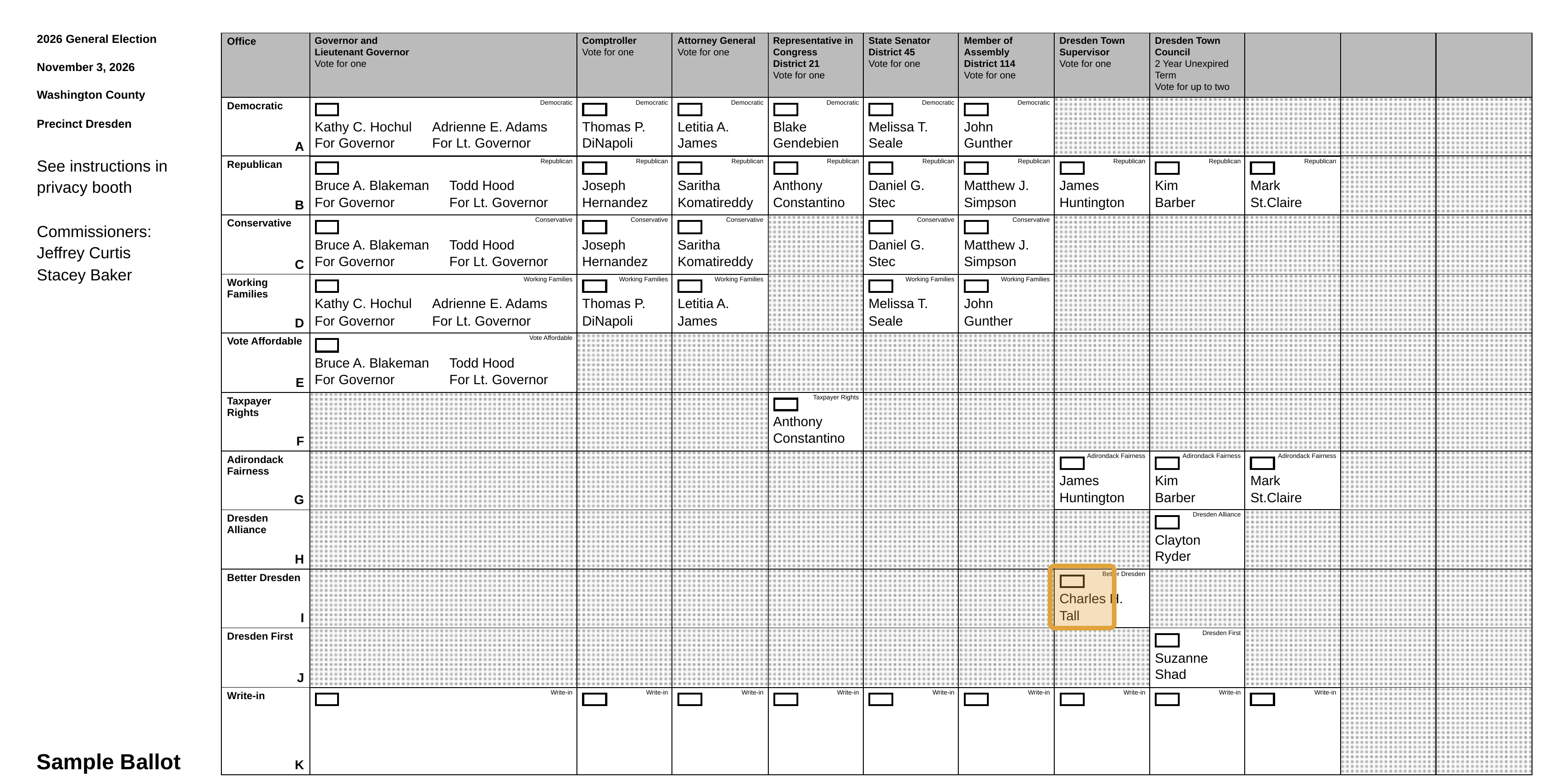
Election Day is Tuesday, November 3. I'm running on the Better Dresden line, for a full term covering calendar years 2027 and 2028.
Over the next 30 years, the Champlain Hudson Power Express (CHPE) will bring Dresden $22.8 million, with the first payment arriving before year end; that's a massive sum for a town our size. I built a company from scratch and ran it for more than 30 years, so budgets and payrolls are familiar ground to me — that's why I'm the right person to shape how this money gets managed from the start, work that will need to continue, and adapt, long after my time as Supervisor. As your Supervisor, I have already used that experience to bring order to the town's finances. I'd appreciate your vote on November 3.
Two grants totaling $120,000 for our sewer system — $80,000 from the Lake George Park Commission and $40,000 from the Lake George Association — for a project that had languished for five years before I got involved and was awarded in autumn 2025, once I helped bring the two organizations to work together.
Idle town funds moved into competitive, interest-bearing accounts, now earning the town more than $35,000 that had gone uncollected before, since the money had simply sat uninvested.
At the county, tax anticipation notes that I introduced, which let the county pay its state retirement contribution early and saved more than $40,000 in interest.
The Board makes the final call on how the CHPE money gets spent, not me alone. But here's where I'd start. To put the size of this money in perspective: the CHPE payments amount to roughly 50 percent of the town's entire general tax levy — what runs the town day to day, outside the fire department and sewer districts — which has run around $800,000 to $850,000 a year in recent years. Our highway department has been the most underfunded part of our town government for several years, and right now it has the biggest needs. I'd put 40 to 50 percent of the CHPE payments toward a proper barn and better equipment and vehicles, over the next 15 years. That's roughly $200,000 to $250,000 a year, more than a 33 percent increase over our current and historical highway budget. Building or rebuilding the town garage will take engineering and feasibility studies, and grants we'll need to seek. It will take long-term, steady planning, not a quick fix. Our crew should know they're driving safe vehicles, with enough garage space to house and work on them properly. It's a serious amount of money, so we wouldn't spend all of it at once. Part of the plan is a proper equipment rotation schedule, so the standard we build stays in place well after the barn goes up. We'll also build a capital reserve fund, ensuring that when the payments end in 30 years, our taxes don't double or triple from suddenly losing money we'd come to rely on. This would be worked out through committees, with public participation built in from the start. Ultimately, the Board will decide, but that is my current recommendation.
I am retired now, but before that I built a company from scratch and ran it for more than 30 years, growing it to about 125 people. That meant a long time being responsible for a budget and for the people who depended on it. During high school my family lived in Lake George village, and I was a townie, graduating from Lake George High School in 1974. I earned a Bachelor of Science degree in engineering from Cornell University, and later in life, after achieving some success, bought land in Dresden in 1998 and built my home on it between 2002 and 2005, where I've lived full time for the past eleven years. From 2003 to 2018, I was also a frequent guest lecturer at Cornell on entrepreneurship and financial markets. I'm also an active member of the Huletts Landing Volunteer Fire Department.
In September 2024, I was appointed Supervisor after the previous supervisor resigned. I took the job with no budget process started for the coming year and very little in the way of organized records, so I rebuilt the town's financial picture from old files and prepared that year's budget on short notice. In November 2025, I lost that seat to the write-in campaign many of you remember. If you'd like more detail, the Sentinel-Times covered it at the time. When the seat came open again this year, I was reappointed in late July to serve through the end of the year, and I am asking you to vote for me, on the Better Dresden line, for the full term that follows: calendar years 2027 and 2028. Sentinel-Times coverage of the reappointment
Beyond Dresden, I serve on the Warren Washington County Industrial Development Agency, which offers incentives to attract businesses and jobs to our region. I also serve on the Lake Champlain Lake George Regional Planning Board, and I've been active in bringing the Lake George Park Commission and the Lake George Association to work together, after their struggles between 2023 and 2025. At the county, I represent Dresden and serve with the 16 other town supervisors on the Washington County Board of Supervisors, which works as the county's board of directors.
On January 1, 2025, I was appointed chair of Washington County's Health and Human Services Committee after the department ran substantially over budget in the 2024 fiscal year. I suggested that we evaluate and hire a consultant, to help guide us through a significant transition, and the board debated and adopted that suggestion. The transition included appointing a new Commissioner of Health and Human Services to succeed the retiring commissioner. In fiscal year 2024, the department exceeded its budget by $4.2 million, though roughly $700,000 to $800,000 of that was a 2023 clawback that only showed up once the 2023 books had closed. By the end of fiscal year 2025, the department had come in under budget by $1.2 million — a reversal in excess of $4 million once you exclude that one-time clawback. We're still working to control costs, but the direction has turned.
At the county, there had been a lot of discussion about whether our carpool and fleet management, including the Sheriff's Department's vehicles, were being run efficiently. With the help of the highway department, I organized the data they had been maintaining into a report for all the supervisors. It showed the efficiency our highway department has maintained, and it helped keep us from entering into expensive leases for the sheriff's vehicles, the kind of leases Saratoga County has taken on. Full report (PDF)
It's no secret the county was also having financial difficulties at the end of 2025. We were worried we wouldn't be able to pay our state retirement system contribution in November, and would have had to pay it in February instead, after taxes arrived, at a substantial penalty. I introduced the idea of tax anticipation notes, or TANs, something the county had never used before. The board looked into it, we adopted it, and it saved the county $40,000.
Dresden's governance has been through a challenging stretch these past two years, including five months without a working board. During that gap, the town had no quorum to take any action at all, and with no zoning law on the books, there was nothing to stop the BESS project, or any other development, from moving forward unchecked. The CHPE payments are arriving at exactly the moment the town needs someone steady and experienced in this seat. Going forward, Dresden needs firm, consistent leadership, not another round of turnover and inexperience, or we won't get the results we're hoping for — someone who will manage this money responsibly, and make sure the town handles the data-center and BESS developers knocking on our door the right way.
I've also put together a plain explainer on how the CHPE payments affect your tax bill (read it here), and a 12-page letter and reference document on the town's review of the Long Lake BESS project, covering the one-year moratorium and the questions we're working through (read it here).
If you have a question about the town's budget, the CHPE payments, the BESS project, or anything else, I want to hear it — you can reach me using the information below.
What you can expect from me is more of what I've already done.
Consistency — I'm asking for a continuation, not a new direction.
Transparency — you should see how a decision got made, not just the outcome.
Openness — real answers when you ask a real question.
Organization — a town that keeps its finances and its records in order.
Accountability — a board that answers for what it decides.
No wasteful spending — every dollar spent benefits all of Dresden, not just part of it.
More public involvement — growing our committees so more residents have a seat at the table.
Team building — committees that work together, not past each other.
A commitment to our employees — an insurance program they can understand while they work for the town, and clarity on what happens if they qualify for retirement.
I'm already involved beyond Dresden, through the county board, the Warren Washington County Industrial Development Agency, the Lake Champlain Lake George Regional Planning Board, and the state associations that bring New York's counties and towns together. I stay at those tables for one reason — to bring back what helps Dresden, because our town matters to us.
This year and the years ahead will ask a lot of whoever holds this office, and I think that calls for someone who already knows how to manage the town's finances and how the board operates. Here's my record this year, in my own words and in the public documents behind it.
This spring, after the resignation of the elected supervisor in February, the town put out a call for anyone interested in filling the supervisor's seat, asking candidates to submit their interest along with a resume and, if they wished, a letter. My opponent, James Huntington, responded with his own assessment in writing. In his letter to the board, dated March 8, 2026, he wrote:
I respect that he said so plainly, and I'd ask you to weigh it against what the town is facing this year.
He had another chance to tell voters more, and didn't take it. On July 27, the board held its public interview to decide who to appoint as interim Town Supervisor. Mr. Huntington and I were the two candidates, but he withdrew minutes before it began. When the board later offered both of us the same list of prepared questions about our background, qualifications, and plans for the town, I answered them, and the Sentinel-Times reported that he declined to.
I'm not asking you to take my word for any of this. His letter, the meeting minutes, and the Sentinel-Times coverage speak for themselves.
I sought the town Republican committee's support this year and attended its caucus. I expected the chance candidates usually get there — to explain who they are and what they'd do in the seat. When I called the committee chairman beforehand to ask how the caucus would run, he told me directly that I could attend but would not be permitted to speak. The plan, he said, was simply to open the doors, hold the vote, and close them again. That's exactly what happened. No candidate for any seat was given the floor, not me and not Mr. Huntington either. Suzanne Shad, running for town council, had the identical experience. Both of us left without having said a word to the people deciding whether to back us. The committee went on to endorse Mr. Huntington for its line; I received no such support. That makes me wonder — and I hope it makes you wonder — how and when anyone was actually evaluated, and by whom.
Both processes were supposed to help people learn about the candidates. In one, I answered every question asked of me, and my opponent declined to. In the other, neither of us was given the chance to say anything at all.
When the Town Board met on September 14, I prepared an explainer on how the CHPE payments affect Dresden's finances and, separately, individual tax bills. The short version: the project adds a Payment in Lieu of Taxes starting around $100,000 a year and growing. There's also a separate Host Benefit Package of about $370,000 a year with no strings attached, plus roughly $20 million in new taxable value on the tax rolls. Because the levy gets divided across a larger base, and because the PILOT can be credited against what the town needs to raise, individual tax bills go down either way, even in the one path where the Board votes to exceed the state tax cap at the levy level. The real decision is how much of that built-in decrease to hand back right away and how much to invest in the highway department and a long-term tax stabilization fund.
On October 1, I sent residents a 12-page letter and public reference document on the town's review of the proposed Long Lake BESS project. It covers the reasoning behind the one-year moratorium I led the Board to adopt in August, the questions we're working through, and the record being built toward a permanent law. I offered it as a reference tool, not as the path Dresden will follow — we'll chart our own path. But the process ahead is significant, and residents should understand it. This is the kind of groundwork I think this office should do in the open, not after a decision is already made.
Questions had come up about what it actually costs the county to operate its own vehicle fleet. The highway department already had the data, so on June 15, 2025, I took it upon myself to prepare that analysis on my own, for the benefit of the county and all its taxpayers. It covers fuel, tires, maintenance, and repairs, broken out by department, for 114 of the county's more than 200 vehicles, including the Sheriff's Department's 55. It's the data behind the cost comparison above — that running the fleet ourselves costs the county significantly less than leasing would.
Two rumors have been circulating, and I'd rather answer them directly than let them sit unanswered.
I understand that concerned voters are encouraging eligible voters to register to vote here in Dresden. I don't direct or control that registration drive, but I have personally helped people close to me — my wife, and a few neighbors who came to me directly — with questions about registering or eligibility.
Some have suggested that when tax rates come down, it disproportionately benefits Huletts Landing because property values there tend to be higher. A tax rate change is a percentage, and that percentage applies the same way to every property in town, regardless of its value or which part of Dresden it sits in. If bills fall by 5%, they fall by 5% everywhere, the same as when they rise by 5%. A higher-value property pays more dollars either way, up or down, but the percentage itself doesn't favor any part of town.
That's the record. I'm asking you to vote for me so I can keep serving Dresden.
I'm asking for your vote for Dresden Town Supervisor. Election Day is Tuesday, November 3, 2026. Early voting runs October 24 through November 1. A couple of official, nonpartisan tools make it easy to check where things stand before then.
Confirm you're registered, and find your polling place, through New York State's own lookup tool.
Register or update your address through the New York State Board of Elections.
Town meetings are held the fourth Monday of each month at 7 PM at Dresden Town Hall. The next one is October 26 — come see the kind of meeting I run, and meet me if we haven't met yet.